
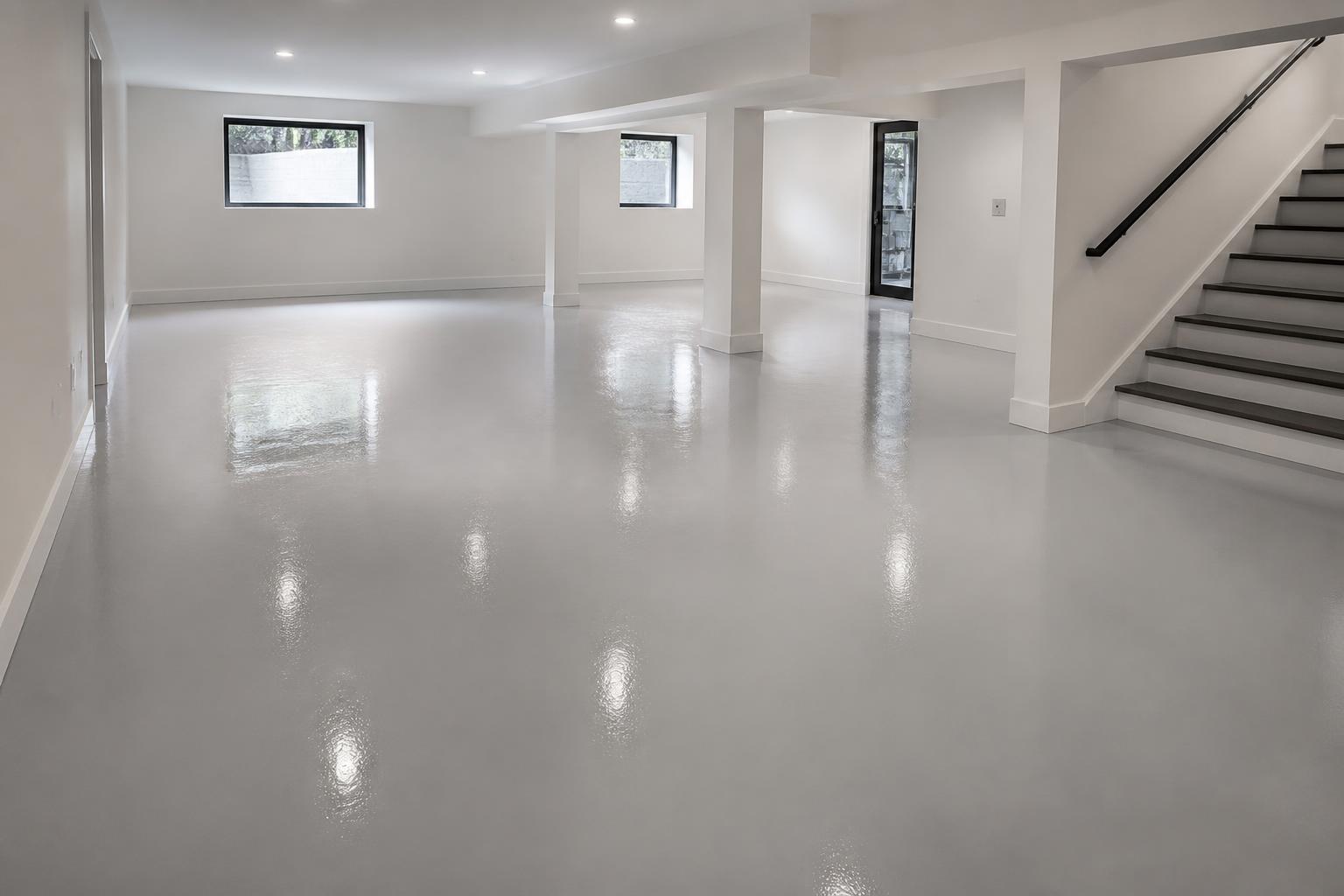
When a solid color is the right call
Solid color makes sense where the priority is a sealed, washable, high-visibility surface rather than a decorative finish — home workshops, mechanical rooms, storage buildings, back-of-house commercial spaces and equipment areas. Light grays and whites bounce fixture light around a windowless basement or garage and make it far easier to work in.
It is also the base layer of most striped, zoned or line-marked floors. Where a facility needs walkways, equipment footprints or safety markings, a solid field color is what those markings go over.
- Most economical professional system per square foot
- Brightens dark garages, basements and utility rooms
- Easy to line-mark and zone for commercial use
- Simplest surface to wash down and inspect
The trade-off against flake
A single uninterrupted color shows everything the slab does. Trowel marks, patched areas and minor undulation stay visible, and dust and tire marks read more obviously than they do on a flake floor. Flake exists partly to camouflage all of that.
Solid color is also smoother underfoot. Where the floor gets wet — a garage that takes snow in on the vehicle, a wash-down area — we broadcast an anti-slip aggregate into the topcoat rather than leaving it slick.
How we install it
The slab is diamond ground to profile, cracks and joints are cut out and filled, and spalled areas are patched. A primer goes down where the concrete is porous or moisture is a concern, then the pigmented body coat, then a clear or pigmented topcoat depending on the specification.
Where the space needs to return to service quickly, we specify a polyaspartic topcoat, which cures fast and holds its color under UV far better than a standard epoxy clear.
Color selection
Standard grays, beiges and safety colors are stocked. Custom pigment matching is available for commercial branding requirements. We review physical samples with you before ordering material so the color in the space is the color you approved.